There is a peculiar luxury in tasting wine exactly where it was made. To stand in a Bordeaux vineyard at dusk, glass raised to the amber light, and drink something that grew in the very soil beneath your feet — this is one of travel's most quietly profound pleasures.
This route connects two of Europe's most celebrated wine regions across a journey of roughly 1,400 kilometers, revealing along the way a France and Italy that visitors who travel only by air-conditioned coach rarely encounter. It is a journey to be taken slowly — a week minimum, two weeks ideally — with attention paid not just to the wine, but to the landscape that produced it.
"Good wine is a good familiar creature if it be well used."
— William Shakespeare, OthelloPart I: Bordeaux & The Médoc
Bordeaux — the city — tends to surprise first-time visitors. Having completed a decade-long urban transformation, it now boasts a remarkably beautiful center, Michelin-starred restaurants, and the world's largest wine museum: La Cité du Vin. Stay in the city for a night before venturing into the Médoc peninsula to the north.
The D2 road through the Médoc is the Route des Châteaux — a straightforward drive north from Bordeaux that takes you past the famous appellations of Margaux, Saint-Julien, Pauillac, and Saint-Estèphe. The great châteaux here — Pichon-Longueville, Léoville-Barton, Lynch-Bages — all offer cellar tours and tastings, though most require advance booking.
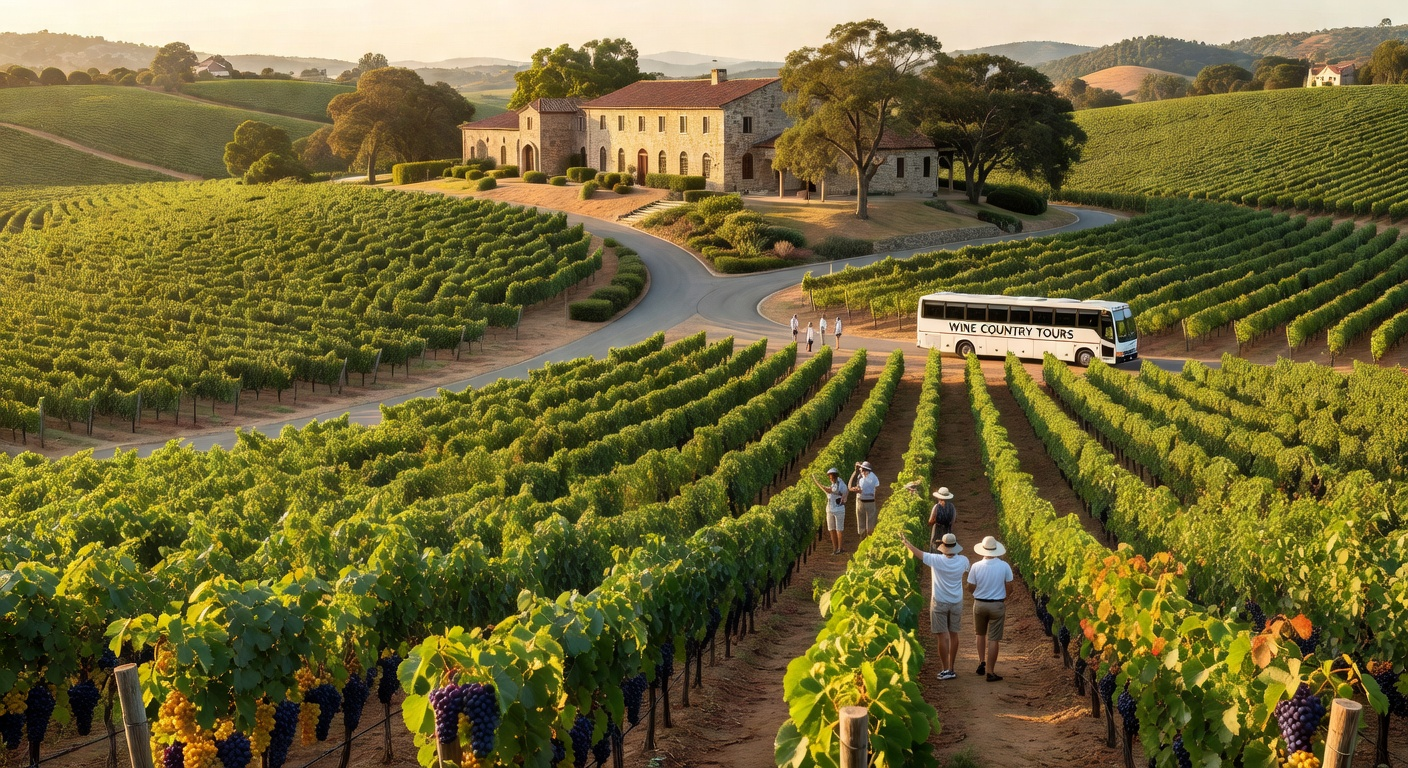
The Médoc at harvest time — the most atmospheric moment to visit, but also the busiest. Book months ahead.
Bordeaux Essentials
- Book château visits at least 2 months in advance for harvest season (September–October)
- The Bordeaux Wine School (École du Vin) offers excellent half-day tasting courses
- Stay in Pauillac village for the most convenient access to the major Médoc appellations
- Try Café Lavinal in Bages — the best casual dining in the Médoc
Part II: The Dordogne Valley
Driving south from Bordeaux into the Dordogne Valley, the landscape shifts from the geometric precision of the Médoc vineyards to something wilder and more romantic — river cliffs, walnut orchards, medieval villages perched on limestone escarpments, and truffles.
Saint-Émilion deserves a full day. One of France's most beautiful UNESCO villages, its entire surface area is built upon an extraordinary network of underground limestone chambers and wine cellars. The wines produced here — Merlot-dominant, rounder and more approachable than the Médoc's Cabernet — reward leisurely exploration.
Part III: The Rhône Valley
Crossing east into the Rhône Valley takes us into completely different wine territory — the powerful Syrahs and Grenaches of the Southern Rhône, and the ethereal, haunting whites of Condrieu and Château-Grillet in the north.
The drive south along the river from Lyon is magnificent — vine-draped hillsides falling precipitously to the water, medieval towers crowning every promontory. Stop in Tain-l'Hermitage to visit Chapoutier or Jaboulet, then continue south to spend a night in Avignon before crossing into Provence.
Part IV: Tuscany's Grand Wine Route
Crossing into Tuscany through the Ligurian coast highway, the first vineyards you encounter are the Cinque Terre's vertiginous terraced whites — bone dry, mineral-edged Vermentino and Albarola grown on cliffs above the Ligurian Sea. They are unlike anything else in Italy.
The Via Francigena road south to Siena takes you through the heart of Chianti Classico — the Black Rooster territory between Florence and Siena that produces some of Italy's most age-worthy wines. The villages here — Greve, Panzano, Radda, Gaiole — are small, genuinely beautiful, and relatively uncrowded outside peak summer weeks.
Further south, the wines grow denser, more powerful. Montalcino's Brunello — arguably Italy's greatest red wine — is grown on hillsides where the view encompasses a vast bowl of golden Sienese countryside. The best producers — Biondi-Santi, Soldera, Canalicchio di Sopra — require appointments made months in advance, but the effort is always repaid.
"The discovery of a wine is of greater moment than the discovery of a constellation. The universe is too full of stars."
— Benjamin Franklin (attrib.)Tuscany Wine Tips
- Chianti Classico Gran Selezione: the top classification, released only in exceptional years
- Avoid August in Tuscany — heat is extreme and many small producers close for vacation
- The Consorzio del Vino Brunello di Montalcino runs an excellent visitor center in the village
- For budget-friendly quality, seek out Morellino di Scansano in the Maremma coast hills
This grand tour — from the elegant, cerebral châteaux of the Médoc to the passionate, terroir-driven estates of Montalcino — is one of travel's great journeys. It rewards the curious, the patient, and above all, those willing to drink slowly and with full attention.